Links and local files go through one queue
YouTube, TikTok, and BiliBili reuse the current media pipeline, podcast platforms use audio parsers, and local files enter the same summary pipeline directly.
SnapVee is an AI video summarizer: paste a public link or upload a local video or audio file,and get instant summaries, timestamped chapters, Mermaid mindmaps, and AI chat for courses, podcasts, livestream replays, and meetings.
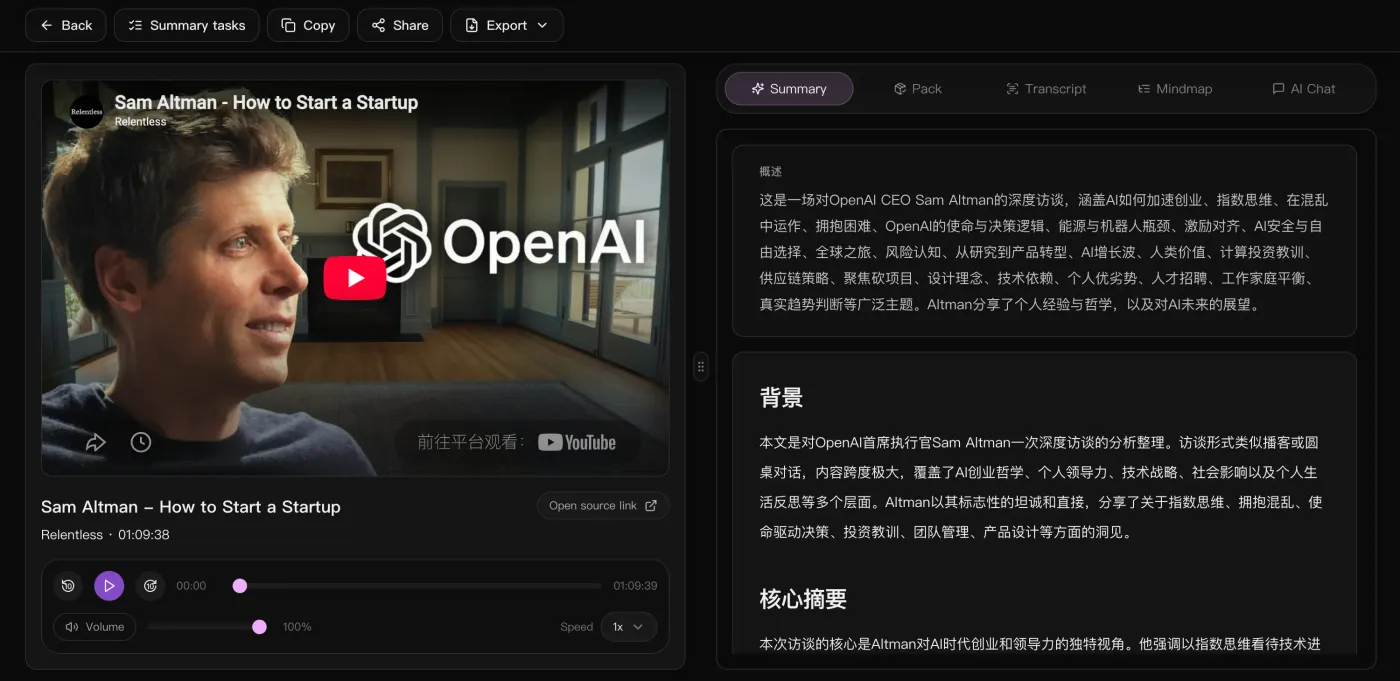
Inside the workspace
The video on the left to check anything against, the overview, background and key takeaways on the right — with the full text, the mindmap and an AI chat one tab away.
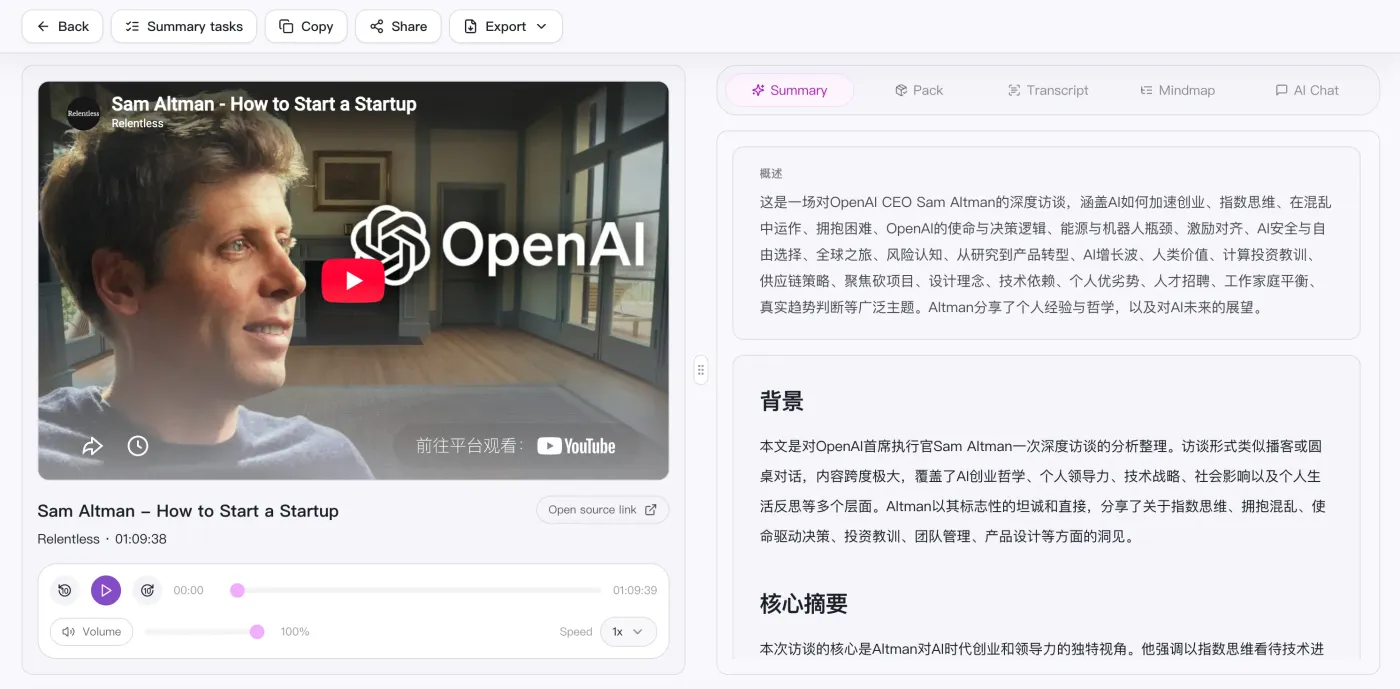
For classes, podcasts, and meeting replays, the result page gives you chapter highlights, a mindmap, and exportable materials you can review or share.
YouTube, TikTok, and BiliBili reuse the current media pipeline, podcast platforms use audio parsers, and local files enter the same summary pipeline directly.
Keep the full original-language transcript with usable timestamps instead of a generic summary blob.
Generate title, overview, chapter bullets, keywords, and action items for study, ops, and meeting follow-up.
The UI renders Mermaid SVG and falls back to a tree view if rendering fails, so the result page stays usable.
After processing, the result page can turn a long video into study notes, a work brief, and an action plan.
Paste a public link or upload a local video / audio file.
Auto-transcribe and generate an overview, chapters, and mindmap.
Keep chatting with AI about the content to dig into points and actions.
Take the summary, mindmap, and action list to reuse anywhere.
Supported platforms
Side by side
How a summarizer built around public links compares with a screen recorder (ScreenApp), a meeting transcriber (Notta) and a YouTube note extension (NoteGPT).
| What matters | SnapVee | ScreenApp | Notta | NoteGPT |
|---|---|---|---|---|
| Getting started | Paste a public link or upload a file in the browser | Record or upload first, then analyze | Join a meeting or upload a recording | Open a YouTube page with the extension |
| Best input | Long videos, podcasts and local audio or video | Screens and calls you recorded | Live meetings and voice notes | YouTube videos above all |
| What you get | Overview, timestamped chapters, key points, Mermaid mindmap, Markdown | Recording summary and highlights | Transcript and meeting minutes | Summary and key points |
| Digging deeper | Keep asking the AI about the full text, switch output language | Ask about the recording | Search across past meetings | Ask about the video |
| After the summary | Subtitles, convert, breakdown, social formatting — same place | Share the recording back | Sync notes to team tools | Export the note |
Compared against each product's publicly observable behaviour, checked August 2026. If screen recording itself is the job, ScreenApp is the better fit, and for live meeting minutes and team collaboration Notta remains the natural pick.
Read the full comparison
You have the notes. Now what?
Same account, same source — export subtitles, break down why it worked, convert the file, lay it out for social. No tool switching.
“Instead of rewatching a 90-minute replay and taking notes manually, I can scan the chapters and jump back only where it matters.”

Oliver Hayes
Product Manager · Meeting review
“For course content, structured summaries are much more useful than raw transcripts when I need to prepare learning materials.”

Emma Sullivan
Course Operations · Knowledge ops
“Long podcast episodes become reusable faster because I can lift chapter titles and summaries into multi-channel publishing.”

Lucas Meyer
Content Editor · Podcast workflow
“A two-hour interview takes ten minutes to skim, and the timestamps jump me straight back to the source to double-check.”

Grace Whitfield
Independent Researcher · Research notes
“Drop in the weekly meeting recording and it produces minutes and action items — no more dedicated note-taker.”

Henry Doyle
Project Lead · Team collaboration
“Even English lectures come out as structured chapters and a mindmap, so prep and review are much faster.”

Clara Jensen
Graduate Student · Course study
Can't find an answer? Reach out to our support team anytime.
GEO fact guides
These guides turn product capabilities, allowances, and usage boundaries into answers you can verify against the relevant tool pages.
Turn public YouTube links into chapters, notes, follow-up chat, and mindmaps.
Review source and translated lines together, fix timing, save, and export.
Use local saving, queues, and file organization for repeated downloads.
Start with a public link. The current focus is making the summary, reading, and export flow solid before anything else.