Read the whole comment section.
Not just the top ten.
Paste a link. SnapVee pulls up to 500 comments — paginated, not just the ones that floated to the top — and returns the sentiment split, the themes people keep repeating, what sells them, what puts them off, and how close they are to buying.
Reddit threads work too — the post title is read as context.
Агрегировано по 180+ комментариям треда; подозрительные заказные и нерелевантные ответы исключены
- Звук оправдывает цену · Высокая (~40% упоминаний)「这个价位能有这音质已经赢了」
- Автономность и стабильность связи · Выше средней (~28%)「一天通勤够用,偶尔会断一下」
- Сборка ощущается дешёвой · Средняя (~18%)「塑料感强,但不影响用」
You'll sign in first — your link comes with you.
Inside the workspace
This is what the review analysis looks like
Hundreds of comments under one post, pulled into a sentiment split, recurring themes that keep the actual quotes, and selling points sitting next to the red flags.
- Sentiment and themes
- Positive, neutral and negative shares — every theme carrying the comment it came from.
- Selling points and red flags
- Two columns: what belongs in your copy, and where the complaints pile up.
- Intent and open questions
- How much real buying intent is in there, plus the questions that become your next video.
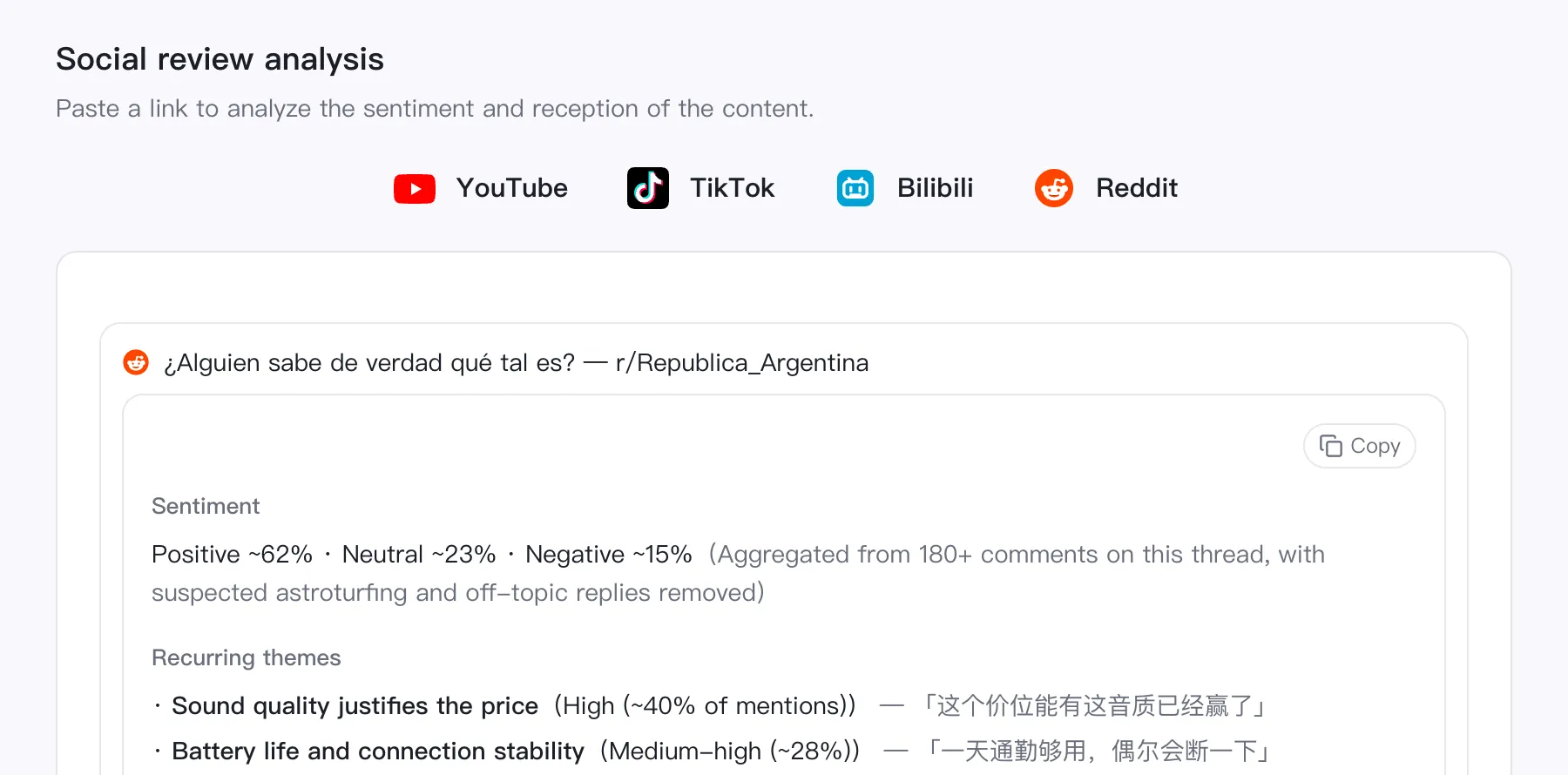
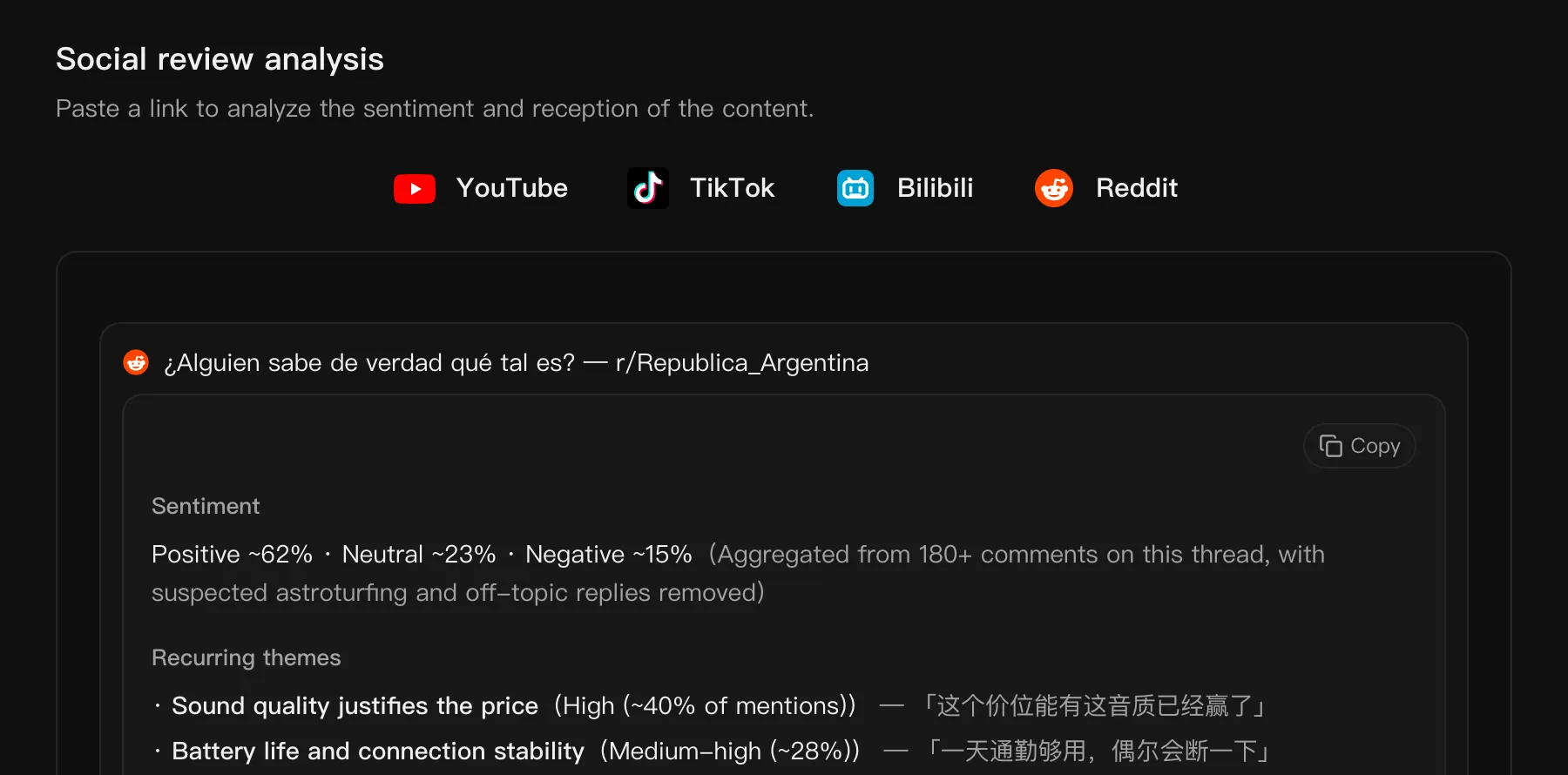
The top comment is the loudest one, not the most common one.
Sorting by likes shows you a joke with 4,000 upvotes and hides the fifty people quietly asking the same question about battery life. Aggregating the whole section is what turns a comment thread into research — which objection actually recurs, which selling point people repeat in their own words, and whether anyone is close to buying.
Sentiment split, with its basis
Positive / neutral / negative shares, plus a note on how many comments it came from and what was filtered out — so you can judge whether to trust it.
Recurring themes
The handful of things people keep coming back to, ranked by how often, each with a real quoted comment rather than a paraphrase.
Selling points by heat
What the audience praises in their own words — usually better ad copy than anything written in a briefing room.
Objections and red flags
The doubts that repeat: price, durability, after-sales, shipping. Answering the top two up front is the cheapest conversion work available.
Purchase intent and a verdict
How close the room is to buying, which signals say so, and a plain read on whether this is worth selling against.
The questions they keep asking
Every recurring question is a piece of content you already know has an audience. They come out as a list you can film from.
Four steps, one link
No scraping setup, no spreadsheet, no reading three hundred comments by hand.
Paste the link
A YouTube, TikTok, Douyin, Bilibili or Reddit URL. One per line if you're batching.
We pull the comments
Paginated through the comment section up to 500 comments, not just the visible top slice.
AI aggregates them
One pass over the whole set plus the title, description and public metrics, returning a structured report.
Turn it into work
Selling points become copy, objections become FAQ, and recurring questions become your next few videos.
What an analysis report contains
Every run returns the same sections, so two products or two competitors are actually comparable.
- 1Тональность
- 2Повторяющиеся темы
- 3Преимущества
- 4Риски
- 5Намерение купить
- 6Частые вопросы (идеи для контента)
- 7Коммерческий вывод
The report is written in your interface language; quoted comments stay in their original language, because translating a quote misrepresents it.
What users say
Sellers, marketers, and creators who read the comment section before they commit.

“Before ordering stock I read what the comments under existing reviews actually complain about. Two of those complaints changed my listing.”

“The selling points come back in the audience's own phrasing. I stopped guessing which angle lands.”

“The questions people keep asking under a popular video are topics with a proven audience. I just answer them.”

“Before a launch I run the comments under competitor reviews. The two objections that kept repeating went straight into our FAQ.”

“Five hundred comments compressed into one page. I don't scroll to page twenty hunting for the useful ones anymore.”

“Purchase intent and red flags listed separately give me something to show my boss before we commit to stock.”
Same account, next step
The rest of the workflow is right here
Pull the video in, turn it into text, work the text into something you can publish — and handle the file chores on the way. No tool switching.
Questions
What it supports, what it costs, and how far it reads.
- Which platforms are supported?
- YouTube, TikTok, Douyin, Bilibili and Reddit. Reddit is review-only, and its post title is read alongside the comments as context.
- How many comments does it read?
- Up to 500 per link, paginated through the comment section rather than taking only the top slice. If a post has fewer, it reads all of them and says how many it used.
- How is it billed?
- A flat 20 credits per link, whatever the platform. No transcription is involved, so there's no per-minute charge. Failed runs are refunded.
- How many links can I analyze at once?
- Up to four per submit without a subscription; subscribers are uncapped. A batch also gets a side-by-side comparison across links.
- Does it handle astroturfing and spam?
- The aggregation drops obvious spam and off-topic replies, and every report states what it was based on. Treat the sentiment split as a read on a public comment section, not a survey.
- Where do the reports go?
- They stay in your workbench history and in My Assets, so you can reopen one later instead of running it again.
Put a comment section to work
Paste a link and get the sentiment, the objections and the questions in a couple of minutes.